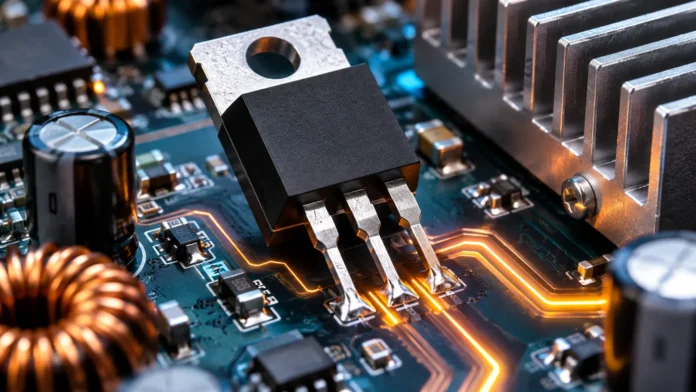

What Does MOSFET Mean?
MOSFET stands for Metal-Oxide-Semiconductor Field-Effect Transistor. It is a type of transistor that controls the flow of electrical current using voltage rather than a continuous control current. MOSFETs are essential components in modern electronic circuits because they can act as switches or amplifiers. You can find them in computers, smartphones, power supplies, electric vehicles, and many household devices.
Understanding the MOSFET meaning becomes easier when you think of it as an electronic switch. A small voltage applied to its control terminal can regulate a much larger current flowing through the device. This ability makes MOSFETs useful for managing electrical power efficiently. Their compact size and fast switching performance also support advanced digital technologies.
Unlike some traditional transistors, MOSFETs have very high input resistance at their gate. This means they require very little steady electrical current to maintain their control state. As a result, they are widely used in energy-efficient electronic systems. Their simple operating principle has helped make them one of the most important semiconductor devices in modern engineering.
How Does a MOSFET Work?
A MOSFET works by using an electric field to control current flowing between two terminals called the source and drain. A third terminal, known as the gate, receives the controlling voltage. When the appropriate voltage is applied, a conductive channel forms or changes inside the semiconductor. This allows electrical current to flow through the device.
In a typical enhancement-mode N-channel MOSFET, applying enough positive gate-to-source voltage creates a conductive channel. Once the voltage exceeds a certain threshold, the transistor begins conducting between its drain and source. Increasing the gate voltage generally allows more current to flow under suitable circuit conditions. The exact behavior depends on the MOSFET’s characteristics and applied voltages.
When the gate-to-source voltage falls below the required level, the conductive channel disappears or becomes insufficient for normal operation. The MOSFET then enters its off state, allowing only a small leakage current. This switching action happens extremely quickly in properly designed circuits. Consequently, MOSFETs are commonly used in high-speed electronics and power conversion systems.
Understanding the Main Parts of a MOSFET
A MOSFET has three primary terminals: the gate, source, and drain. Some devices also provide a separate body or substrate connection, although it is often internally connected to the source. Each terminal performs a specific function in controlling electrical current. Understanding these connections is important when learning how a MOSFET operates within an electronic circuit.
The gate terminal controls the transistor by creating an electric field across an insulating layer. This insulation prevents normal direct current from flowing through the gate into the semiconductor channel. Meanwhile, the source and drain provide the main current path when the device conducts. Their roles and voltage relationships depend on the MOSFET’s type and circuit configuration.
The semiconductor body contains the region where the conductive channel develops. An insulating oxide layer separates the gate electrode from this semiconductor material. This structure gives the MOSFET its name and distinctive electrical characteristics. The insulation also explains why MOSFETs have high gate input impedance and can be controlled with relatively little steady power.
Different Types of MOSFETs Explained
MOSFETs are commonly classified into two main operating categories: enhancement-mode and depletion-mode devices. Enhancement-mode MOSFETs are normally off when the gate-to-source voltage is zero. They require an appropriate gate voltage to create a conducting channel. These devices are widely used in digital circuits, switching applications, and modern power electronics.
Depletion-mode MOSFETs operate differently because a conductive channel already exists at zero gate-to-source voltage. Applying a suitable gate voltage can reduce or increase the channel’s conductivity. These transistors are less common in everyday switching applications but remain useful in specialized circuits. They may appear in current sources, analog designs, and particular electronic control systems.
MOSFETs are also categorized as N-channel or P-channel devices based on their conducting carriers. N-channel MOSFETs primarily use electrons, while P-channel MOSFETs primarily use holes. Both types can be manufactured in enhancement or depletion configurations. Their electrical behavior determines where they fit best in switching networks, amplifiers, and complementary circuit designs.
N-Channel vs P-Channel MOSFETs
An N-channel MOSFET typically turns on when its gate voltage becomes sufficiently positive relative to its source. Electrons carry most of the current through its conductive channel. Because electrons generally move more easily through silicon than holes, comparable N-channel devices often have lower resistance. This makes them popular in efficient power switching applications.
A P-channel MOSFET generally requires a sufficiently negative gate-to-source voltage to turn on. It conducts primarily through positively charged carriers called holes. These transistors are often useful for high-side switching, where a circuit needs to control a positive supply connection. Their drive arrangements can be simpler than certain N-channel alternatives in low-voltage systems.
Choosing between N-channel and P-channel MOSFETs depends on circuit requirements. Designers consider switching position, available gate voltage, current handling, resistance, and efficiency. N-channel devices are frequently preferred for demanding power applications because of their favorable electrical characteristics. However, P-channel MOSFETs remain valuable when simpler high-side control is more important than minimum resistance.
MOSFET Operating Regions and Their Functions
MOSFETs operate in different regions depending on the voltages applied to their terminals. The three commonly discussed regions are cutoff, linear or triode, and saturation. Each region describes how current responds to changes in gate and drain voltages. Understanding these regions helps engineers select suitable operating conditions for switches and amplifiers.
In the cutoff region, the MOSFET does not have a sufficiently conductive channel for normal operation. In the linear or triode region, it behaves approximately like a voltage-controlled resistance. This region is useful when a MOSFET acts as a fully activated electronic switch. Proper gate drive helps reduce resistance and power loss during conduction.
In the saturation region, a MOSFET’s drain current becomes less dependent on drain-to-source voltage under idealized conditions. This behavior is especially useful in analog amplification and current-control circuits. Importantly, MOSFET saturation is different from the fully switched-on condition commonly associated with bipolar transistors. Recognizing this distinction prevents confusion when studying transistor characteristics.
Key MOSFET Characteristics and Specifications
One important MOSFET specification is the gate-to-source threshold voltage, commonly written as VGS(th). This value indicates when a specified small amount of drain current begins flowing. However, threshold voltage does not tell you when the transistor is fully turned on. Designers must check additional specifications to determine the appropriate gate-drive voltage.
Another critical specification is drain-to-source on-resistance, written as RDS(on). It describes the resistance between the drain and source when the MOSFET is properly activated. Lower on-resistance generally reduces conduction losses and improves efficiency. However, actual resistance changes with temperature, gate voltage, and operating conditions, so datasheet values require careful interpretation.
Maximum drain-to-source voltage, continuous drain current, gate charge, and power dissipation are also important specifications. Voltage ratings indicate the electrical stress a device can withstand within specified limits. Gate charge influences switching speed and driver requirements. Thermal resistance and safe operating area help determine whether a MOSFET can operate reliably under expected electrical loads.
Common Applications of MOSFETs in Electronics
MOSFETs are widely used in computers, smartphones, and other digital devices. Modern processors contain enormous numbers of tiny MOS transistors arranged into complex circuits. These transistors perform logical operations that make digital processing possible. Their ability to switch quickly while using relatively little power has supported decades of progress in semiconductor technology.
Power electronics is another major application of MOSFET technology. MOSFETs help regulate electrical energy in DC-DC converters, power adapters, battery management systems, and motor controllers. Their rapid switching ability supports efficient voltage conversion. Properly selected power MOSFETs can reduce wasted energy and help electronic systems operate at manageable temperatures.
MOSFETs also appear in audio amplifiers, LED lighting systems, automotive electronics, and solar power equipment. In some circuits, they amplify electrical signals rather than simply switching power. They also help control loads such as motors and lighting components. This versatility makes them useful across consumer electronics, industrial automation, and renewable energy technologies.
Advantages of Using MOSFETs
One major advantage of MOSFETs is their high input impedance. The insulated gate requires very little steady control current, making voltage-based operation practical. This characteristic can reduce the control power required by electronic circuits. However, the gate still needs electrical charge during switching, so fast operation requires suitable drive circuitry.
MOSFETs also offer fast switching speeds, which are valuable in modern power supplies and digital systems. Rapid switching allows designers to use higher operating frequencies in suitable applications. This can support smaller energy-storage components and more compact circuit designs. Actual efficiency depends on switching losses, gate charge, operating frequency, and overall circuit design.
Another benefit is the wide variety of MOSFETs available for different voltage and current requirements. Designers can choose small signal devices, low-resistance power transistors, or specialized semiconductor structures. Their widespread use also makes them familiar components in electronics development. Together, these advantages explain their importance in both simple products and complex industrial systems.
MOSFET Limitations and Common Challenges
Despite their advantages, MOSFETs have limitations that designers must consider. Their insulated gates can be vulnerable to excessive voltage and electrostatic discharge. Improper handling or circuit protection may damage the gate insulation. For this reason, manufacturers specify maximum gate-to-source voltage limits and recommend appropriate precautions during circuit assembly and testing.
Heat generation is another important challenge, especially in power applications. Electrical current flowing through on-resistance creates conduction losses, while switching transitions produce additional losses. Excessive heat can reduce efficiency and shorten component life. Suitable cooling arrangements, thermal design, and correct component selection are therefore essential for reliable performance.
MOSFETs can also experience switching problems when gate drivers are inadequate. Slow transitions may increase power losses, while unwanted voltage spikes can place additional stress on the device. Parasitic capacitances and inductances influence performance in high-speed circuits. Engineers address these effects through careful circuit design, layout planning, and appropriate protective components.
MOSFET vs BJT: What Is the Difference?
MOSFETs and bipolar junction transistors, commonly called BJTs, are both semiconductor devices used for switching and amplification. However, their control methods are different. A MOSFET primarily responds to voltage applied between its gate and source. A BJT uses base current to control a larger current flowing between its collector and emitter.
MOSFETs generally have higher input impedance and can offer excellent switching efficiency in suitable circuits. BJTs may be useful where their current gain, voltage characteristics, or analog behavior meets design requirements. Neither transistor type is automatically better for every application. The correct choice depends on operating conditions, frequency, power requirements, and circuit complexity.
In digital electronics, MOSFETs dominate because they work effectively in complementary semiconductor structures. BJTs still appear in amplifiers, current-control circuits, and specialized electronic designs. Engineers sometimes combine both transistor technologies within a single system. Understanding their differences helps beginners recognize why electronic products use several transistor types rather than relying on one universal solution.
How to Choose the Right MOSFET
Selecting a suitable MOSFET begins with understanding the circuit’s voltage and current requirements. The chosen device needs ratings that safely exceed expected operating stresses with appropriate design margins. Engineers also evaluate whether the available gate voltage can activate the MOSFET sufficiently. Choosing a device based only on threshold voltage can lead to poor switching performance.
Efficiency is another important consideration when comparing MOSFET specifications. Low on-resistance helps reduce conduction losses, while suitable gate charge characteristics can improve switching performance. These factors often involve tradeoffs rather than one perfect specification. Designers should evaluate the MOSFET under actual circuit conditions instead of relying entirely on headline datasheet figures.
Package size, thermal resistance, availability, and manufacturing requirements also influence component selection. A compact package may fit a small circuit board but require careful thermal management. Different applications may prioritize efficiency, cost, switching speed, or reliability. For beginners, learning to interpret datasheets is one of the most useful steps toward understanding practical MOSFET selection.
Conclusion
Understanding MOSFET meaning is an important starting point for learning modern electronics. A MOSFET is a voltage-controlled semiconductor transistor that can regulate electrical current through an electric field. Its basic structure includes a gate, source, drain, and semiconductor body. These elements work together to support efficient switching and signal amplification across numerous electronic applications.
MOSFETs are available in several types, including N-channel, P-channel, enhancement-mode, and depletion-mode devices. Each configuration has different operating characteristics and practical uses. Specifications such as threshold voltage, on-resistance, maximum voltage, and gate charge help determine suitable applications. Understanding these details makes electronic circuit concepts easier to recognize and evaluate.
From smartphones and computers to electric vehicles and renewable energy systems, MOSFET technology plays a major role in everyday life. Its combination of switching performance, compact size, and efficient control makes it valuable across many industries. Learning how MOSFETs operate provides a foundation for exploring semiconductor devices, electronic circuit design, and power management technologies.
Frequently Asked Questions
What Is the Full Form of MOSFET?
MOSFET stands for Metal-Oxide-Semiconductor Field-Effect Transistor. It is an electronic component that uses voltage applied to an insulated gate to control electrical current between its source and drain terminals.
What Is the Main Purpose of a MOSFET?
The main purpose of a MOSFET is to control electrical current. It functions as an electronic switch or amplifier and is commonly used in power supplies, digital circuits, motor controllers, and electronic devices.
Is a MOSFET an AC or DC Device?
A MOSFET can operate in circuits involving both AC and DC signals. It controls current according to applied terminal voltages, while the surrounding circuit determines how it handles changing or steady electrical conditions.
What Is the Difference Between a MOSFET and a Transistor?
A MOSFET is a specific type of transistor. The term transistor includes several semiconductor devices, while MOSFET specifically refers to an insulated-gate field-effect transistor controlled primarily by voltage.
Why Are MOSFETs Used in Power Electronics?
MOSFETs are widely used in power electronics because they can switch rapidly and offer low conduction resistance when properly activated. These characteristics help improve efficiency in converters, motor controllers, and power management systems.

